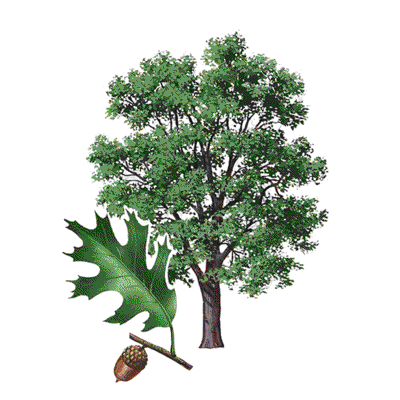
ENGLISH OAK
(Common Oak - Quercus Robur)
Fruit - Acorn, produced after 40 years of growth.
Generally found in the South-East and Central parts of Britain.
The oak thrives in clearings of fallow trees and is less tolerant
to the shade, but in well sheltered and deep soil areas
it can grow up to 130 feet and more, and live for as long as 300 years.
In former times, oak was felled in vast quantities, up to 500,000 tons a
year and sometimes twice this amount, with 90,000 tons a year of
oak bark being used in the leather tanning industry.
A common phrase was that cities and navies were built on oak.
Today as a major hardwood it is used in joinery and furniture making
and also in boatbuilding due to its bending quality,
with lower grade oak used in fencing, mining timbers, gates, etc.
Royal Oak Day
29th May is Royal Oak Day or Oak Apple Day and commemorates the
restoration of the monarchy in 1660. It was started by Charles II
who earlier had evaded the Roundheads by hidding in a hollow oak tree.
'Great oaks from little acorns grow.'
Oaks have lots of other uses too!
Wine can be made from the leaves;
colour dye from the bark and coffee from acorns,
the seed of the oak tree. Acorns are also a favourite food of pigs.
And as one mature oak can produce 50,000 acorns they have plenty
to pick over!
Some of our oldest oaks have been growing for over 500 years, and they
are still producing acorns, so if you grow an oak as your Tree of Time
and Place, it could still be looking wonderful half way
through the next Millennium.
How to grow an oak tree from seed
Choose the oak tree from which you wish to gather your acorns.
The crop is much better in some years than others,
but the harvesting couldn't be easier.
Picking
Don't pick the acorns from the tree,
they're not ripe if still on the branches.
Keep one eye on your chosen tree, and the other on the weather.
Wait until the first strong wind of autumn shakes the branches
and scatters the seeds, then gather just a few of the plumpest,
shiniest acorns from the ground, you'll need to be quick to beat
the squirrels and jays.
Check that the acorns are healthy.
The simplest way to do this is to put them in a bucket of water.
If they float, they won't grow,
so just choose the acorns that sink.
Give the rest to the birds - they'll enjoy what you don't want.
Potting
Plant each of your acorns in its own pot filled almost to the top
with garden soil or compost(peat free is more environmentally friendly).
Any container will do - a yoghurt pot, or root trainer.
Make sure there are drainage holes in the bottom,
and just cover the acorn with the compost.
Squirrels, jays, and mice all love acorns, and they will eat yours
given half a chance, so cover them over with a fine wire mesh
and try to keep them out of reach if you think they are at risk.
Watering
Stand your pots on a tray or a saucer - something to hold a little
water - and put your pots in a shady, sheltered spot, out of doors.
Never let your pots dry out - but don't let them get waterlogged
either. Water from the top until the seeds germinate
(sprout above the soil) - this can take up to 3 weeks.
From then on pour water into the tray at least once every week,
and let the compost soak it in through the drainage holes in the
bottom of each pot. If you add 'water storage crystals' to the compost,
this greatly reduces the danger of the seedlings drying out.
Growing
Then wait and be patient.
It could be May before your new seedlings appear,
and don't poke around to see if they are growing.
The young roots and shoots are very easily broken.
Your oak seedling will grow quite happily in the pot,
minimum size 150mm (6 inches) tall for most of the next two
summers. You shouldn't need to feed it.
Planting
When your oak seedling is at least 200mm (8 inches) tall,
it is big enough to plant in its permanent home. Choose a place with
enough space for your oak to grow. You can either plant the tree
on your own, with friends or wait for the Millennium planting day.
Prepare the site (an area at least the size of a dustbin lid),
scrape away any weeds or grass and make a small hole.
This should be approximately 150mm deep.
Soak the roots of the seedling tree first, then take it out of its pot,
and plant it carefully into the centre of the 'clearing',
and firm the soil.You don't need to tie it to a stick,
it will grow quite strongly enough on its own,
but you should put in a marker, so no one mows it or pulls it up.
You might add a tree guard if rabbits are a problem!
There are two native oak trees in Britain: the common,
or pedunculate, oak (scientific name Quercus robur)
and the durmast, or sessile, oak (Quercus petraea).
They are deciduous, meaning they lose all their leaves
in the autumn and grow new ones in the spring.
Other kinds of oak, which have been brought from abroad,
are the Turkey oak and the Holly oak.
he holme oak (Quercus ilex) is evergreen.